What Are KPIs and Why Do They Matter for Your Business?
What are KPIs, and why do they matter for your business? KPIs, or Key Performance Indicators, help you focus on the numbers that actually matter. Learn the difference between KPIs and metrics, explore practical KPI examples for small businesses, and see how the right data can support better business decisions.

With a solid background in computer science, big data analytics, and accounting, he takes a methodical approach to customizing your platform or product to ensure you get the absolute best return on your investment.
www.linkedin.com/in/salonikios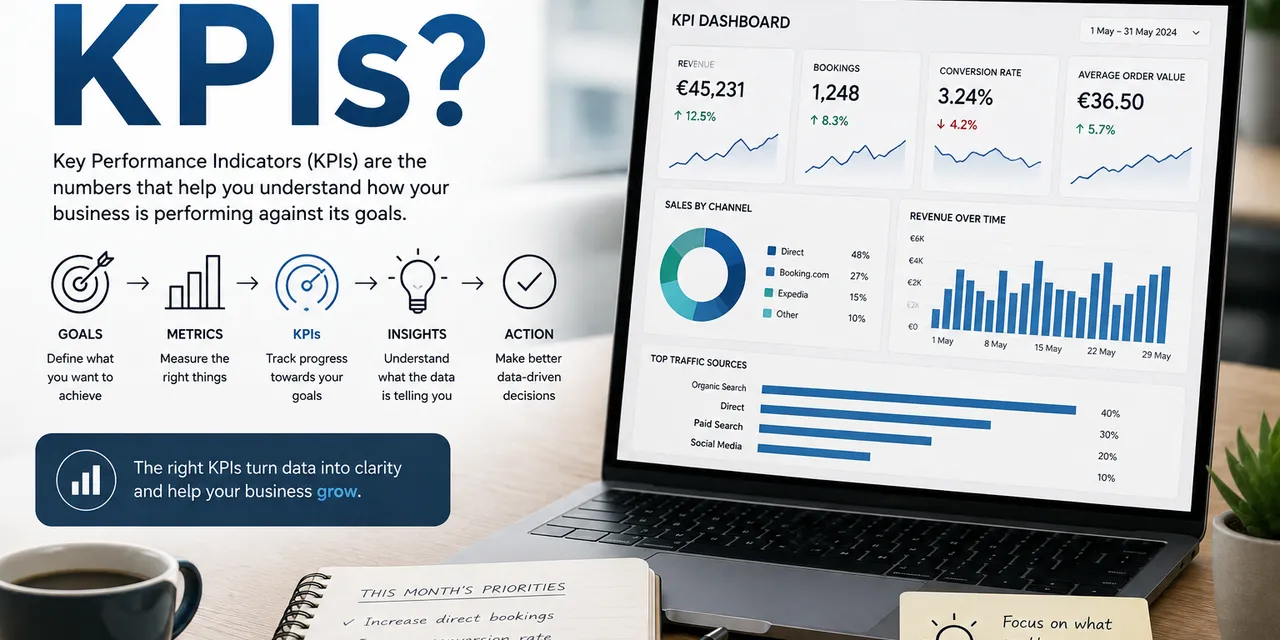
A business can have plenty of numbers.
You may know your revenue, how many customers you have, how many bookings you receive, how many people visit your website, and how many orders you process.
But there is a more important question:
How is the business actually performing?
Having more data does not automatically make that question easier to answer.
Often, the problem is not a lack of information. It is having too much of it, without knowing which numbers really matter.
That is where KPIs come in.
What are KPIs?
KPI stands for Key Performance Indicator.
In simple terms, a KPI is a number that helps you understand whether your business is moving towards an important goal.
For example, imagine a small hotel that wants to increase direct bookings through its website.
It can track website visits, enquiries, bookings and many other numbers.
But one particularly useful KPI might be the percentage of website visitors who book.
That number is closely connected to the goal.
And that is the key point:
Not every number is a KPI.
A KPI is a measurement chosen because it tells you something important about how the business is performing.
KPI vs metric: what is the difference?
The terms KPI and metric are often used interchangeably, but there is a useful distinction.
A metric is simply something you can measure.
A KPI is a measurement that matters because it is linked to an important business goal.
| Data | 500 orders |
| Metric | Average order value: €32 |
| KPI | Increase average order value by 10% |
The same metric can be a KPI for one business and much less important for another.
For a restaurant, average order value may be very useful. For another business, customer retention may matter much more.
So the right question is not:
“What can we measure?”
It is:
“What do we need to know to understand whether we are achieving our goal?”
Why are KPIs important?
KPIs help business owners and managers see what is happening more clearly.
They can help answer questions such as:
- Are we moving in the right direction?
- Is an investment or campaign working?
- Is performance improving or declining?
- Where should we focus our attention?
Imagine that your website traffic increases by 30%, but sales stay the same.
The first number sounds positive.
The second tells you that something may be wrong.
Perhaps the website is attracting the wrong visitors. Perhaps the offer is unclear. Perhaps the booking or purchase process is too complicated.
The KPI does not give you the answer by itself.
It helps you ask a better question.
What are the main business KPIs?
There is no universal list of KPIs that works for every business.
The right business KPIs depend on your goals and industry.
Financial KPIs
Common examples include:
- Revenue
- Gross margin
- Net profit margin
- Cash flow
- Average transaction value
Sales KPIs
You might track:
- Sales growth
- Conversion rate
- Average order value
- New customers
- Repeat customers
- Customer acquisition cost
Marketing and website KPIs
Depending on your business, these could include:
- Website traffic
- Organic traffic
- Leads and enquiries
- Conversion rate
- Online bookings
- Online sales
- Customer acquisition cost
Customer and operational KPIs
These may include:
- Customer satisfaction
- Review ratings
- Repeat purchase rate
- Response time
- Service time
- Occupancy
- Cancellation rate
You do not need to track all of them.
In fact, tracking too many can make it harder to see what really matters.
KPI examples for small businesses
Hotel or accommodation business
A hotel may track:
Occupancy — how much of its available room capacity has been sold.
ADR — the average price paid for occupied rooms.
RevPAR — a measure that combines room price and occupancy.
It may also track direct booking rate, cancellations and average length of stay.
The right choice depends on the hotel's goals. If the main objective is increasing direct bookings, then direct booking performance should be more important than simply looking at website traffic.
Restaurant or café
A restaurant might track:
- Average order value
- Number of orders
- Food cost percentage
- Online orders
- Repeat customers
- Table utilisation
Suppose orders increase but profit does not.
That is a signal to look more closely at pricing, food costs or the amount customers spend per visit.
Small business with a website
A smaller business could start with just a few measures:
- Website traffic
- Enquiries
- Conversion rate
- Online sales
- Customer acquisition cost
These numbers can answer practical questions:
Are the right people finding us? Are they getting in touch? Are they becoming customers? And what does it cost to acquire a new customer?
How do you choose the right KPIs?
The simplest approach is to start with the business goal.
- Define the goal.
What are you trying to improve — sales, profitability, bookings or customer retention? - Define success.
Make the goal specific enough to measure. - Choose the relevant KPI.
Which number best shows whether you are getting closer to that goal? - Track it over time.
One number tells you little. A trend gives you much more information. - Review it regularly.
As your business changes, your priorities and KPIs may need to change too.
This is also where clear, measurable goals become useful. A good KPI should tell you whether you are making progress, not simply give you another number to look at.
Why you don't need to measure everything
It is easy to collect data today.
Website visits, clicks, social media activity, advertising results, bookings, reviews, orders and sales can all be measured.
But:
More data does not automatically mean better decisions.
A business can have dozens of reports and dashboards and still struggle to answer a basic question: What should we do next?
That is why useful KPIs should be connected to real business questions.
For example, the number of people who saw an advert may be interesting.
But if the goal is to win more customers, it may be much more useful to know how many people contacted you, how many bought from you and how much it cost to acquire them.
The best KPI is not necessarily the most impressive number.
It is the number that helps you make a better decision.
From data to better decisions
A simple way to think about the process is:
Data → What is happening? → What does it mean? → What should we do?
Imagine website traffic is increasing while sales remain flat.
That suggests something is happening between the website visit and the purchase.
You can then investigate the booking process, page content, pricing or offer.
This is where data analytics and Business Intelligence (BI) become useful.
Their purpose is not simply to create more charts. It is to help businesses understand their data and use it more effectively.
What is a KPI dashboard?
A KPI dashboard brings your most important business numbers together in one place.
Instead of checking several different systems, you can have a single view of revenue, bookings, traffic, conversion rates or other important measures.
A good dashboard should make it easier to answer one question:
What needs my attention?
It does not need dozens of charts.
It needs the right information, presented clearly.
From KPIs to better business decisions
The goal of KPIs is not to create more reports.
It is to help you understand your business better.
This is where technology, data analytics and Business Intelligence can become practical tools for small and medium-sized businesses.
agénor.BI develops digital and data-driven solutions designed around real business needs, with experience across areas including hospitality, tourism and restaurants. The focus is not on adding technology for its own sake, but on using the right tools to make business information more useful.
That might mean a better website, a booking solution, a reporting dashboard or a digital product that helps collect and use business data.
The starting point should always be the same:
What do we need to understand, and what decision do we need to make?
Because ultimately, the goal is not to measure more.
It is to understand more — and make better decisions because of it.